Incremental Sync Strategies for Large Multi-Tenant SaaS Datasets
Four patterns for syncing multi-tenant data without creating incidents.
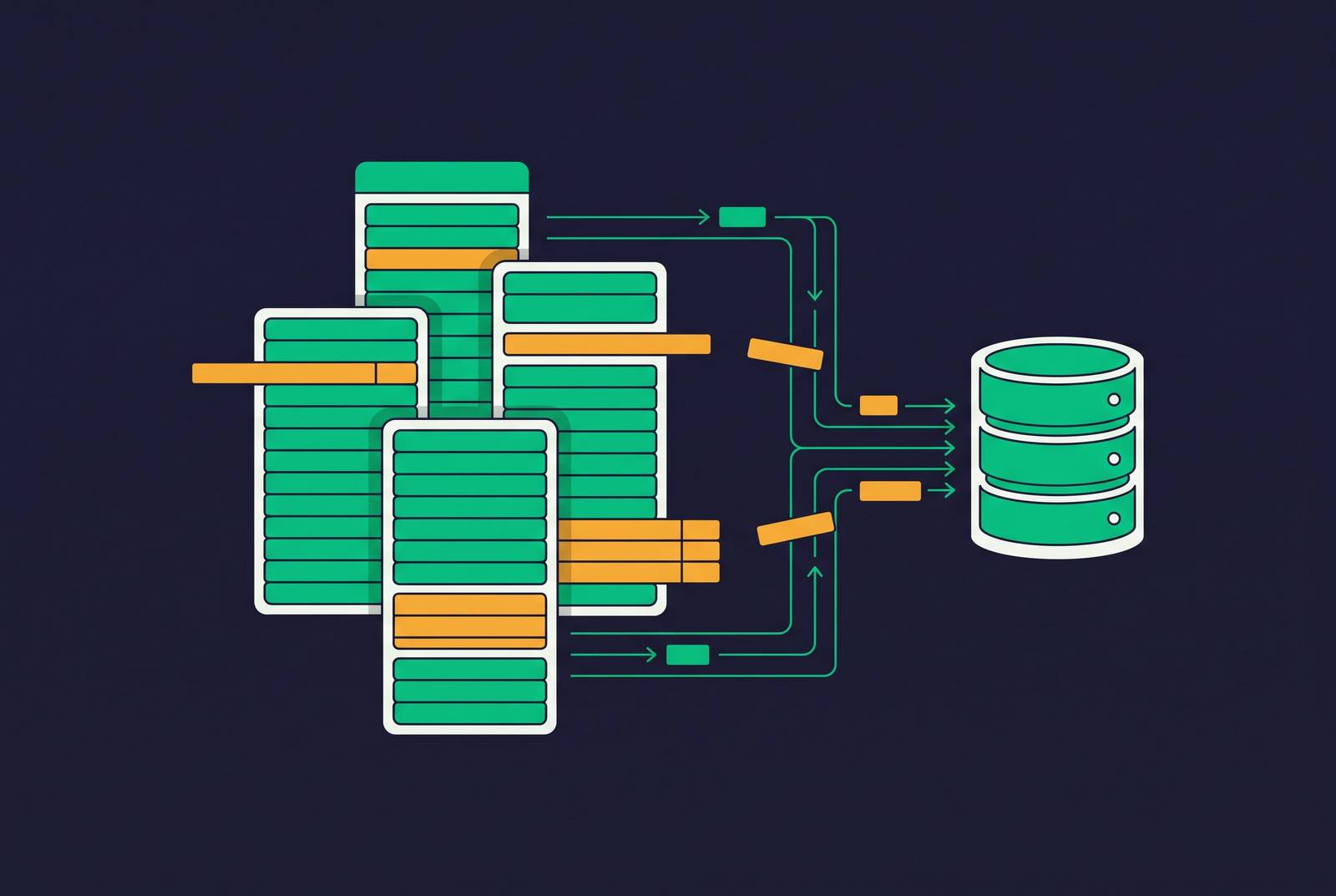
Syncing a large multi-tenant SaaS dataset incrementally takes more than a timestamp column and a cron job. It needs a strategy that accounts for tenant isolation, the mechanism you use to detect changes, scheduling that scales with uneven tenant sizes, and freshness guarantees that differ by tenant tier. This piece works through the four main approaches, cursor-based sync, log-based change data capture, watermark partitioning, and hybrid models, and how each one holds up under the specific pressures multi-tenant systems put on it.
A full table scan works fine at small scale. Running that same job against a database with thousands of tenants and wildly different data volumes creates trouble that compounds: wasted compute cycles, data that goes stale between runs, and one tenant's job stepping on another's. Shared infrastructure creates a structural tension. Shared infrastructure has to serve tenants whose data volumes, change rates, and freshness needs can be an order of magnitude apart from each other, and a sync design that ignores that gap will eventually be forced to reckon with it, usually during an incident.
Multi-tenancy adds constraints that a single-tenant sync job never has to think about. Isolation means one tenant's sync process can't read, expose, or delay another tenant's rows, full stop. Noisy-neighbor risk means a large tenant's sync job can quietly starve smaller tenants of compute and I/O on the same shared infrastructure. Compliance adds another layer: an incremental delete or a GDPR right-to-erasure request has to propagate for the tenant that requested it, not bleed into anyone else's data. And credential sprawl becomes real once each tenant connects to its own external destination. The sync layer has to hold isolated auth state per tenant rather than one shared credential.
None of this is theoretical. SaaS teams field a growing pile of integration requests from customers, commonly in the range of 12 to 15 per quarter, and engineering teams are reported to spend around 30% of their time just keeping existing connectors alive rather than building new ones. That's the operational cost of a naive sync approach: a third of engineering time going to upkeep instead of new work.
Three multi-tenant database patterns and how they constrain sync options
Three database architectures dominate multi-tenant SaaS, and each one decides, in advance, what your sync options even look like.
Shared schema with row-level security is the cheapest to run. Every tenant's rows live in the same tables, and a tenant_id column paired with RLS policies keeps them apart. It scales to a large number of tenants without much operational strain. But each cursor and each CDC event has to carry tenant context, and a missing filter isn't a slow query, it's a data leak. GDPR deletion is hardest under this model too, because a delete meant for one tenant has to somehow avoid touching another tenant's rows sitting in the same table.
Schema-per-tenant gives each tenant a dedicated PostgreSQL schema inside one shared database instance. Isolation is stronger, and per-tenant migrations are simpler to reason about. The cost lands on the sync layer: jobs need to be instantiated per schema, and schema drift, where one tenant's migration history has diverged from another's, can break a connector built to assume a single shared structure. This pattern holds up well into the low thousands of tenants, but the operational overhead climbs as tenant count grows.
Database-per-tenant is the most isolated option, and the easiest to explain to an auditor, since each tenant's data sits in a physically separate database. It's typically reserved for enterprise tiers running on dedicated infrastructure. Sync logic per tenant is simple, one pipeline, one database, but provisioning and credential management scale linearly with tenant count, and connection pool exhaustion becomes a real operational risk once the tenant count climbs.
A paper on ResearchGate covering multi-tenant SaaS data mart architecture points to dynamic metadata management, tenant-aware partitioning, and policy-driven access control as the three levers that make an architecture hold up at scale. That framing matters here because it confirms the trade-off is structural. It's structural.
The practical upshot: the database architecture a team picks isn't just a compliance decision made once and filed away. It decides whether one CDC stream can serve every tenant, or whether the sync layer itself has to be built for parallelism from day one.
Cursor-based incremental load and its limits under multi-tenant load
Cursor-based sync tracks a high-watermark value, usually an updated_at timestamp or an auto-incrementing ID, and on each run it pulls only the rows where that column has moved past the last recorded value. It's usually the first approach any team reaches for, because it needs no extra infrastructure, works against any relational database, and is easy enough to explain to a new engineer in five minutes.
Two sync modes sit inside this pattern. Incremental append just fetches new or changed rows and adds them to the destination; it's the simplest to build but piles up duplicates unless something downstream deduplicates them. Upsert, or merge, matches on primary key and overwrites the existing row, which keeps the destination clean but only works if the destination actually supports efficient merge operations, which not all of them do well at scale.
The failures show up specifically at multi-tenant scale: clock skew causes rows written by different tenant processes to land with timestamps trailing slightly behind the recorded watermark, purely from distributed clock drift, and those rows get silently s... Clock skew causes rows written by different tenant processes to land with timestamps trailing slightly behind the recorded watermark, purely from distributed clock drift, and those rows get silently skipped, not flagged, skipped. Cursor-based sync also can't see hard deletes at all: a tenant deletes a record, and the destination just keeps it forever unless someone's built a soft-delete flag or a tombstone record into the source schema. In shared-schema setups, a single global watermark creates a different problem: a fast-moving tenant drags the watermark forward, and a slower tenant's not-yet-synced rows get treated as already covered. And backfills get expensive fast: re-syncing one tenant's full history, during onboarding or after fixing a bug, means running a full-table cursor scan that locks or strains the shared table for every other tenant sitting on it.
Change Data Capture: how log-based CDC behaves differently in multi-tenant environments
CDC works at a different layer. It reads the database's own transaction log, the WAL in PostgreSQL, the binlog in MySQL, and emits an event for every committed insert, update, and delete. It reads the database's own transaction log, the WAL in PostgreSQL, the binlog in MySQL, and emits an event for every committed insert, update, and delete. That's the part timestamp cursors can't do: CDC catches hard deletes, and it catches them in the order they actually happened, not the order a timestamp column implies.
That's precisely why it matters for multi-tenant SaaS. CDC is the only one of these mechanisms that reliably propagates deletes, handles writes that arrive out of order, and does it with low overhead on the source database, since it's reading committed log entries rather than running queries against live tables.
Not all CDC is built the same way. Log-based CDC reads committed transactions straight from the storage layer: lowest overhead, full fidelity, and no changes needed to the source schema. Trigger-based CDC writes a change event to a shadow table on every single write, which adds write amplification to every tenant's transaction and gets expensive fast once volume climbs. Timestamp-based CDC is really just the cursor approach from the last section wearing a different name, and it carries the same blind spots.
Multi-tenant environments add their own wrinkles on top. In a shared-schema setup, a single WAL stream carries every tenant's events interleaved together, so the consumer has to demultiplex by tenant_id and route each event to the right destination without letting one tenant's data cross into another's. Schema-per-tenant setups often need a separate replication slot per schema in PostgreSQL, and that has real resource costs: if a slot falls behind, WAL retention on the source can grow without bound until someone notices. Onboarding a new tenant onto a shared table brings its own risk, since taking an initial snapshot of a large table can't lock it for everyone else using it; Debezium 2.5+ addressed this directly by introducing incremental snapshots that avoid table locks. And CDC pipelines commonly operate with at-least-once delivery rather than exactly-once guarantees, so the consumer on the receiving end has to be idempotent, upserting by primary key, or duplicate rows will occur in the destination when the same event is delivered more than once.
Watermark partitioning and tenant-aware scheduling for uneven tenant populations
A scheduler that treats every tenant identically, same interval, same priority, is a scheduler that will eventually let a handful of large tenants eat all the sync resources while small tenants either starve or get synced far more often than they need, wasting compute for no benefit.
Watermark partitioning fixes the first half of that problem. Each tenant keeps its own watermark record, a last-synced offset or timestamp that belongs to it alone, and sync jobs run scoped to a single tenant's partition rather than scanning the whole table at once. Partition size gets bounded too, a cap on rows per run or a fixed time window, so no single tenant's backlog can hold the whole queue hostage.
Scheduling by tenant tier fixes the second half. Enterprise tenants on tighter SLAs get shorter sync intervals and priority in the queue. Free or trial tenants get longer intervals and lower priority, and under load, their syncs get pushed back rather than yanked mid-run. None of this works, though, unless the scheduling layer actually knows which tenant tier it's looking at. Tenant metadata has to live in the scheduler itself, not just in a billing table somewhere else.
Mitigating noisy neighbors at the scheduler level comes down to a short list of levers: rate limiting the rows or events a single tenant's job can pull per run, throttling a job that's consuming disproportionate I/O and backing it off gracefully instead of letting it run unchecked, and weighted fair queuing so no tenant's job can monopolize worker threads meant to be shared. Autoscaling compute to match usage patterns, balancing tenant workloads across available capacity, and caching layers that cut down on repeat query execution round out the documented set of mitigations teams reach for here.
Hybrid sync models: combining cursors, CDC, and batch for different tenant tiers
No single mechanism covers every tenant well. A free-tier tenant with a few thousand rows and a large enterprise account with tens of millions don't belong on the same sync strategy, and trying to force them onto one is how teams end up either overspending on infrastructure for small tenants or under-serving large ones. A tiered hybrid model assigns the mechanism by tenant characteristics instead.
A workable tier map looks something like this. Small or free tenants get cursor-based incremental sync on a longer interval, hourly or daily is plenty, since the operational overhead is low and the freshness bar for this tier isn't demanding; hard deletes get handled through periodic reconciliation rather than needing real-time propagation. Mid-market tenants move to cursor-based sync with shorter intervals and their own per-tenant watermarks, running in upsert mode to catch late-arriving updates, with a soft-delete pattern built into the source schema so deletes don't vanish silently. Enterprise tenants get log-based CDC with sub-minute latency, idempotent upsert logic at the destination, a dedicated replication slot or a managed CDC pipeline, schema evolution tracked through a schema registry, and in some cases, database-per-tenant isolation to back the whole thing up.
Object storage has a role in this picture too, particularly for tenants syncing into a data warehouse or lakehouse. Incremental data can land in S3-compatible object storage as staged files first, then get merged into an open table format like Apache Iceberg. Iceberg takes on the parts of this that used to live in the sync pipeline itself: ACID transactions, schema evolution, time travel, partition pruning, all handled at the storage layer instead. And the ceiling on what a single file can hold moved recently, too: late in 2025, according to AWS, the maximum S3 object size rose from 5 TB to 50 TB. Large incremental payloads can now land as a single object instead of getting split across multiple parts.
Some hybrid setups also need to sync in both directions, not just from source to destination but back again, particularly where a downstream system's changes need to reach back into the tenant's source database. That adds its own layer of conflict resolution and isolation requirements on top of everything already covered here, and it deserves its own treatment rather than a rushed mention at the end of this one.