Role-Based Access Control for Multi-Tenant Warehouse Export Systems
Row-level security alone cannot stop data leaks in shared-schema multi-tenant systems.
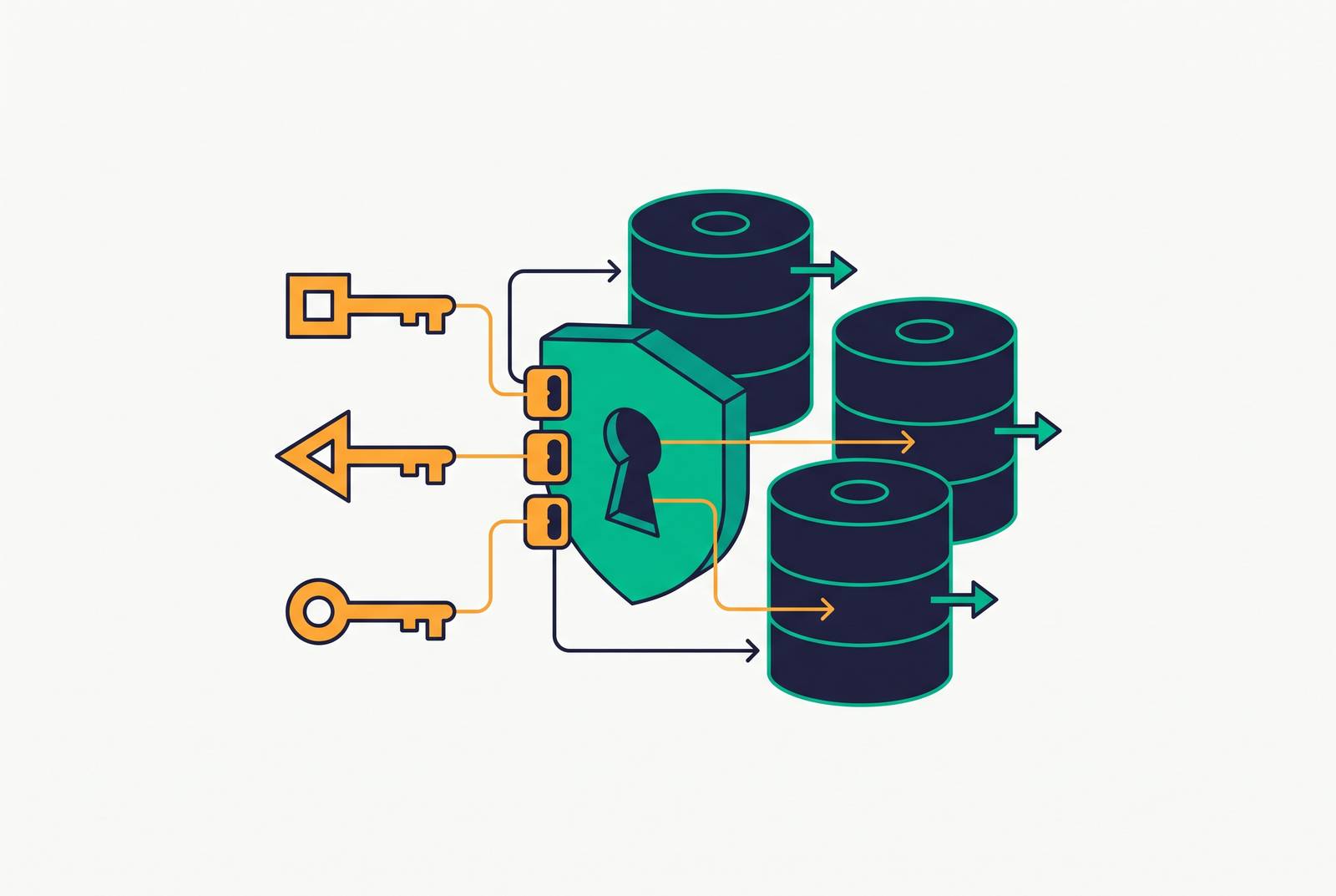
Multi-tenant warehouse export systems fail because RBAC alone was never the whole job. They fail because RBAC alone was never the whole job. Role-and-grant primitives tell you what a user can do to a named object, full stop. They say nothing about which rows in that object belong to which customer, which pathways can pull data out, or whether the resulting log trail would survive a real audit. Tenant isolation that actually holds needs a stack of four layers: role hierarchy, row-level security, export controls, and audit logging, each one closing a gap the layer before it leaves wide open.
Start with the basics, since the foundation matters here. In warehouse systems like Snowflake, a role is an object assigned to a user inside an account, whether that account belongs to a data provider or a data consumer. Grants connect roles to database objects: grants connect roles to specific privileges on database objects, determining what operations a role may perform. USPTO patent 12169580 describes container-centric managed access, where future grants get pre-defined for objects that don't exist yet, so a new table dropped into a schema inherits the right access rules automatically instead of sitting exposed until someone remembers to grant permissions on it.
The appeal of role-and-grant is obvious. It maps cleanly onto an org chart, it's simple to reason about, and a five-person data team can set the whole thing up in an afternoon. That's why it becomes a trap. Ask any Snowflake admin who's onboarded a new account: most teams get through setup by handing out SYSADMIN and moving on, then spend the next year clawing that access back once the data footprint grows and a compliance officer starts asking who can see what. Role-and-grant answers who can access which named object, and that's all it answers. It has nothing to say about row ownership, export routes, or whether the audit trail is even complete, and those are exactly the places multi-tenant systems actually break.
The three tenancy patterns that determine which RBAC layers you need
Which layers a team needs depends first on how tenants sit inside the warehouse physically, and there are two workable patterns here, plus a third that sits above both as scale eventually forces a choice.
Schema-per-tenant gives each customer a dedicated schema inside one shared database. Isolation happens at the schema boundary, migrations stay scriptable, and an admin can still run a cross-tenant query when something needs debugging. The pattern holds up fine from around 50 tenants up to roughly 1,000. Past that range, the operational cost turns brutal: a single DDL change, adding a column, altering a constraint, has to run across every one of those schemas in lockstep, and that cost becomes the dominant thing eating engineering time.
Shared schema with a tenant_id column and row-level security is the answer once schema-per-tenant stops scaling. All tenants sit in the same tables, and RLS policies filter rows at query time based on tenant_id. Above roughly 1,000 tenants, this pattern isn't really a preference anymore, it's close to mandatory, since the overhead of maintaining thousands of schemas becomes the dominant cost driver in the whole system. But shared schema carries the opposite risk profile: it's the most scalable option on offer, and also the most dangerous one if a single RLS policy is missing or misconfigured. A misconfiguration in shared-schema RLS can expose data across tenants in a way a schema-boundary failure simply can't.
Row-level security as the first enforcement layer and its known failure modes
RLS is the primary mechanism that makes shared-schema multi-tenancy safe, and it earns the weight the industry gives it. But it's one layer, not the whole solution. Multi-tenant analytics also needs identity flow validation end to end, caching that's properly scoped, ongoing role hierarchy audits, export pathway protection, and a log of every schema change, because RLS only governs the query path someone actually wrote it to cover. Nothing outside that path gets touched.
Column-level security is a separate tool solving a separate problem, and The distinction is concrete in practice. When every user is allowed to see the same rows but certain columns need to stay hidden from most of them, fields like email, phone number, name, or card number, native column-level security mechanisms built into the warehouse engine are the right tool. Views are the wrong one here: a view is not an adequate substitute for native column-level security controls, no matter how it looks on a whiteboard.
Performance affects query latency at scale, and it's a detail teams get wrong often enough to flag directly. The RLS filter predicate should sit on a column populated specifically for access control at ingestion time, and how that column interacts with the query engine's partitioning and clustering choices deserves real attention, not an afterthought pass during code review.
Most warehouse engines apply this same split: separate mechanisms handle per-tenant row filtering and sensitive-column masking, and neither one substitutes for the other.
The export pathway gap that RLS and role hierarchies do not close
The gap that RLS, no matter how carefully it's configured, cannot close on its own. A user restricted in the UI can often still pull raw, unfiltered data through an API that was never wired up to apply the same RLS rules. That failure pattern appears wherever a product team built the UI security layer first and treated the export API as something to bolt on later.
The fix starts with treating every access pathway, including the primary UI, as its own audit surface. Direct SQL clients, REST APIs, scheduled pipeline jobs, embedded SDK calls, all of them need the same scrutiny the main dashboard gets, because each one is simply another door into the same data.
The reason this gap sticks around is structural. Role grants live inside the warehouse account. Export pipelines, meanwhile, often run under a single service account carrying broad warehouse permissions, because that's the easiest way to get a pipeline working on a Tuesday afternoon. The pipeline's identity ends up with more access than any individual end user should ever hold, and every export that runs through it inherits that excess quietly.
Closing the gap takes three things working together, not one silver-bullet fix. The exporting identity has to carry tenant context, not just warehouse credentials, so the system knows whose data is moving even when the pipeline's own permissions run broad. The export destination has to be tenant-scoped, since a shared destination that relies only on folder structure isn't a real security boundary, just a filing convention. And volume or frequency limits matter too, not only for performance reasons but because a sudden spike in export volume from one tenant's credentials is itself a signal worth catching.
Role hierarchies, privilege escalation, and session management in DBaaS contexts
Privilege escalation in a multi-tenant warehouse comes down to three rules that all have to hold at once: role assignment, role authorization, and permission authorization. Missing any one of the three leaves a path to escalation sitting open: a user assigned a role they shouldn't have, a role authorized for an action it shouldn't perform, or a permission attached to the wrong object.
Database-as-a-service adds a threat that's easy to overlook, mostly because it comes from inside the trust boundary rather than from outside it. A database administrator needs full privileges to do maintenance work, that's simply the job description. But in a multi-tenant DBaaS setup, that same privileged account, if misused, becomes a confidentiality risk whose reach extends well beyond any single tenant's slice of data.
Session management is skipped most often in RBAC design discussions, and it shouldn't be. A session opened with elevated privileges for one legitimate task can persist beyond its intended scope if the session credentials aren't bounded tightly to a specific tenant and a specific operation.
The structural answer to all of this is least-privilege grant design applied at the query level: each operation gets only the minimum privileges it actually requires, rather than inheriting the full privilege set attached to its role. That's a narrower standard than most role hierarchies enforce today, and it's the one that actually limits how far a compromised session, or a misused admin account, can reach into the system.
Audit mechanisms that make the entire layer stack verifiable
None of the layers above mean much if there's no way to check they're actually working, which is what makes audit logging the mechanism tying the whole stack together rather than a nice-to-have bolted on at the end. Audit log completeness should reach full coverage validated on a weekly cadence, beyond just when the certification auditor comes calling once a year.
A complete audit record has to go further than who accessed what. It needs the SQL that actually ran, the warehouse it ran against, the user who triggered it, and the result count that came back. Cover all four of those fields for every query, and there's a real trail. Missing one leaves a gap someone will eventually find at the worst possible time.
Some platforms make this harder than it needs to be, purely through architectural complexity. Microsoft Fabric's permission model runs across four layers of interaction, and one specific priority rule trips up more admins than any other part of the system: a workspace-level private link setting overrides a tenant-level setting, not the other way around, which is the opposite of what most admins assume walking in. Neither the workspace admin nor the tenant admin actually intended the resulting permission state. It just gets discovered later, when someone can't access something they should, or can access something they shouldn't.
Schema changes need their own audit trail too, kept separate from query-level logging. Every DDL change to a tenant schema, a dropped column, an altered policy, has to get logged as its own event. Without that log, a schema change that quietly removes an RLS policy looks identical to an honest configuration mistake, and there's no way to tell the two apart after the fact unless the change itself got recorded at the time.
Embedded data integration platforms in the layered architecture
Embedded and white-label integrations shift the threat model in a specific way: the SaaS vendor controls the pipeline, but the end customer controls the warehouse it feeds into. RBAC has to function across an ownership boundary between two different companies, not just within a single account under one administrator's control, and that's a much harder problem than it sounds.
Given that split, there's a baseline security posture any embedded data integration vendor serving B2B SaaS customers ought to be able to demonstrate on request. That means recognized compliance certifications, standard identity federation protocols, automated user provisioning, and audit logging that attributes every query back to the specific end user who ran it, not just the service account that happened to execute it.
Embeddable's architecture reflects the pathway concerns raised earlier: encrypted connections, access controls enforced server-side, row- and database-level security, tenant-aware permissions built in from the start rather than added later. It's built around SDKs, Web Components, and APIs, a deliberate move away from iframe-heavy embedding, and that matters because iframes introduce security boundaries that are harder to control than purpose-built embedding approaches.
Holistics takes a different structural approach: hierarchical workspace multi-tenancy, with one master workspace holding the shared data model and dashboards, and child workspaces underneath it provisioned programmatically. Its embedding architecture offers multiple tiers, which gives teams a real choice between how much control they want over the embedded experience and how fast they want to ship it.
Putting the layers in sequence: a design checklist for teams building multi-tenant export
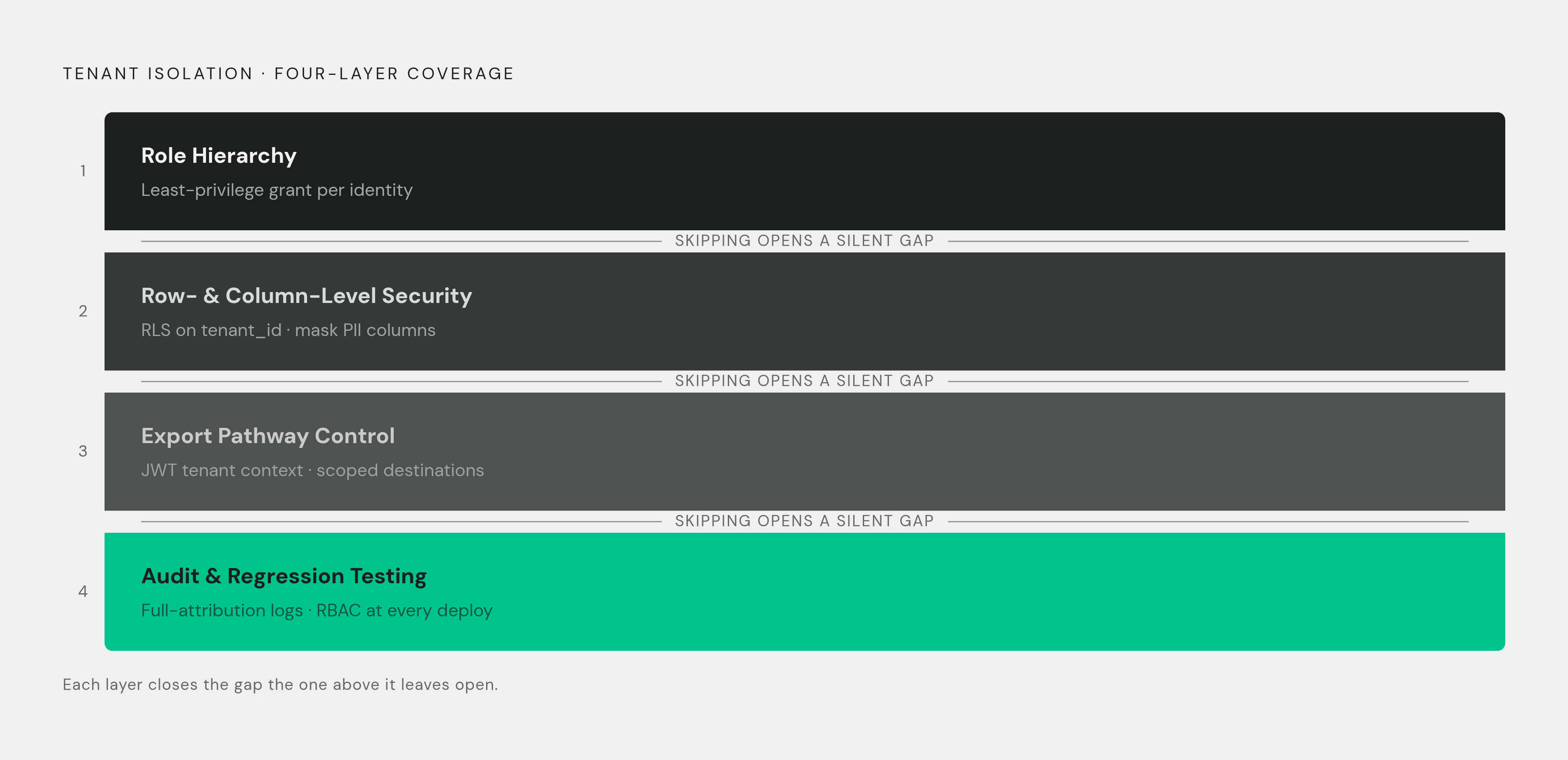
Building this stack in the right order matters just as much as building each layer correctly on its own, since a later layer stacked on top of a weak earlier one just inherits that weakness and hides it for a while.
Layer one is identity and role design. Define the role hierarchy before a single grant gets issued, apply least-privilege from day one instead of retrofitting it under pressure later, and refuse to let standing service accounts hold elevated, always-on access. Session credentials should get scoped to a specific tenant and a specific operation, not to a role's entire permission set, which echoes the DBaaS and Snowflake patterns covered above.
Layer two is row- and column-level security. RLS goes on the tenant_id column, or its equivalent, populated at ingestion time specifically for this job and nothing else. Column-level security for PII fields should use whatever native tool the warehouse engine actually provides: the native column-level security or dynamic data masking features the warehouse engine provides. Views are never an acceptable substitute for column-level security, no matter how convenient they look in a sprint planning meeting.
Layer three is export pathway control. Every export pathway gets audited on its own terms, independent of whatever the UI happens to enforce. Tenant context belongs in the JWT or equivalent token at the session level, not bolted on somewhere downstream after the fact. Export destinations need to be tenant-scoped, and where a product writes out to more than one warehouse target, policy enforcement has to hold consistently across all of them, not just the one that got built first because it was easiest.
Layer four is audit and regression testing. Every access event gets logged with full attribution, and audit log completeness gets checked weekly against a full-coverage standard, not deferred until certification season rolls around. RBAC regression testing belongs in the deploy pipeline itself: role propagation latency, JWT claim extraction failures, cache invalidation behavior, super-admin bypass checks, run at every single deploy, not only the ones that touch permissions code directly.
Four layers, built in that order, is what closes the distance between "RBAC is configured" and tenant isolation actually holding under real load. Skipping a layer leaves the gap in place. It just waits quietly for the deploy that finds it.